Experiență utilizator is often the deciding factor between an event that feels chaotic and one that feels polished, memorable, and easy to navigate. In a world where attendees expect instant updates, seamless planning, and personalized interactions, the way you design the event journey matters as much as the content itself. A strong agenda eventului and timely notificări live can transform confusion into clarity, reduce friction, and help every participant feel informed, included, and in control.
A successful event is not only about the stage, speakers, or venue. It is about how easily people can move through the experience from the moment they register until the final session ends. When attendees know where to go, what is happening next, and how to react when plans change, they engage more deeply. That is why modern event organizers increasingly focus on digital tools that enhance communication and create a smoother attendee journey. For a broader view on digital transformation for events and services, you can also explore conversie site în aplicație.
At the heart of this approach is experiență utilizator: the way people perceive every touchpoint, from registration to check-in, from the agenda to the final feedback form. When each step is clear and responsive, the event feels more premium, more trustworthy, and easier to enjoy.
Cuprins
- Why experiență utilizator matters at events
- The role of a clear agenda eveniment
- How notificări live improve event communication
- Designing a seamless attendee journey
- Practical benefits for organizers and attendees
- Best practices for better experiență utilizator
- The future of event engagement
- Conclusion
Why experiență utilizator matters at events
Every interaction at an event contributes to the overall experiență utilizator. From checking in at the entrance to finding a workshop room or receiving schedule updates, each step shapes how attendees perceive the event. If the process feels intuitive and well-organized, people are more likely to stay engaged, network confidently, and leave with a positive impression.
On the other hand, when information is scattered or difficult to access, attendees may feel frustrated or disconnected. They may miss sessions, arrive late, or fail to participate in key activities. A strong user experience prevents these problems by making essential information visible, timely, and easy to act on.
In practice, this means designing the event around the attendee’s perspective. What do they need to know right now? How quickly can they access the agenda? What happens if a speaker is delayed or a room changes? The answers to these questions should be built into the event experience from the start.
Good experiență utilizator also reduces pressure on staff. When participants can self-serve the information they need, the event team can focus on delivering value instead of answering the same logistical questions all day. That operational efficiency is one of the most overlooked benefits of better digital design.
It also improves the emotional side of the event. When participants feel that the experience is built for them, they are more patient during small delays and more willing to explore sessions they might otherwise ignore. That sense of ease is a major part of what makes an event feel successful.
For organizers, the impact goes beyond satisfaction scores. Better usability often leads to higher attendance at sessions, smoother movement between activities, and fewer interruptions for staff. In that sense, experiență utilizator is both a service quality issue and a practical management tool.
The role of a clear agenda eveniment
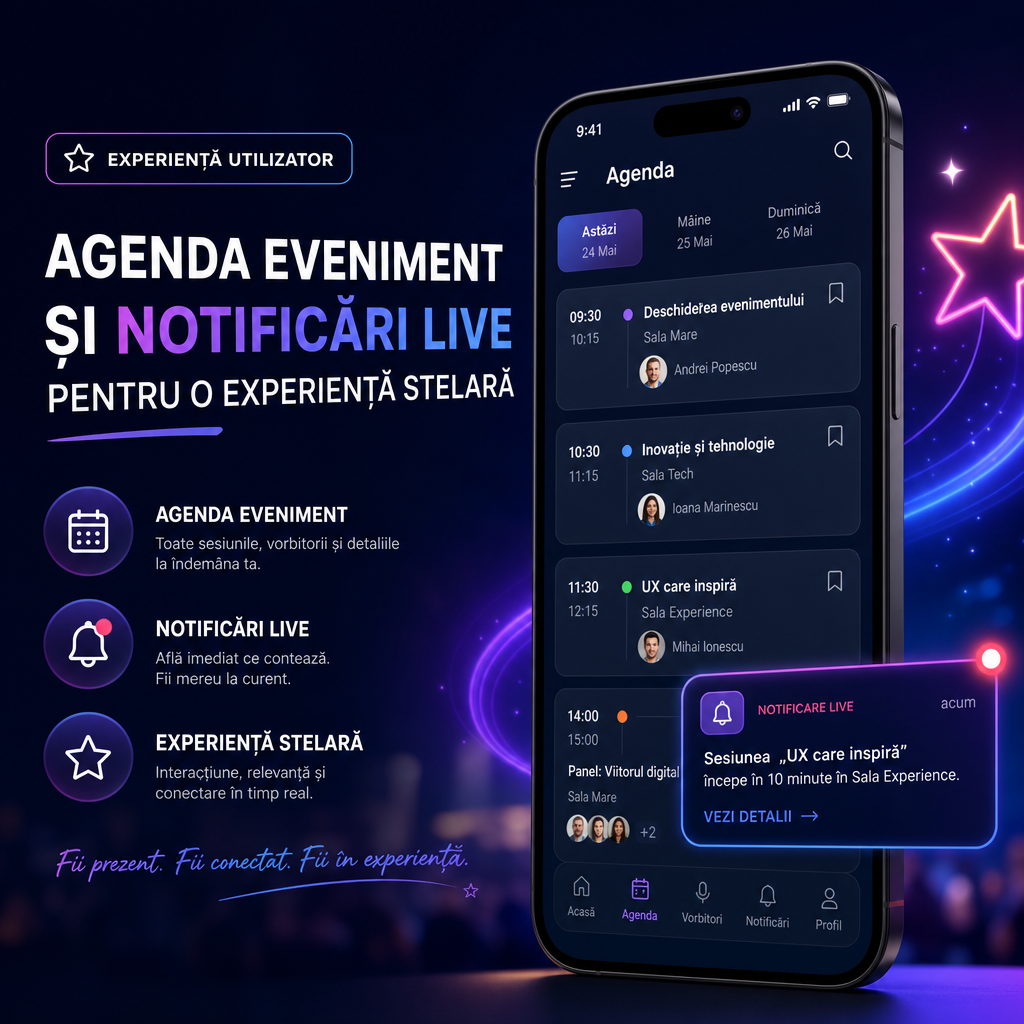
An agenda event serves as the backbone of the attendee journey. It gives structure to the day, sets expectations, and helps participants prioritize the sessions that matter most to them. A well-designed agenda is not simply a list of time slots. It is a navigation tool that helps people make better decisions throughout the event.
To be effective, the agenda should be easy to scan, visually clear, and accessible across devices. Attendees should be able to see the session title, time, location, speaker, and any special instructions without searching through multiple pages or emails. A digital agenda also allows real-time updates, which is essential when schedules shift.
Personalization makes the agenda even more valuable. If attendees can bookmark sessions, build a custom schedule, or filter by topic, they gain a stronger sense of control. This improves engagement because people are more likely to attend the content that is relevant to them. A personalized agenda eventului also reduces the risk of missed opportunities, since reminders can be linked directly to selected sessions.
For example, many organizers now use mobile experiences similar to those described in Aplicație mobilă în 7 pași cu Appify, rapid și sigur to make the agenda easier to access on the go. That kind of mobile-first approach fits naturally with modern attendee expectations.
A clear agenda also helps people plan around the event, not just during it. Participants often want to know what they can realistically attend, whether there are overlapping sessions, and which activities deserve priority. When those details are easy to see, they can make smarter choices and feel more satisfied with their schedule.
In larger conferences, the agenda may include multiple tracks, networking breaks, sponsor activations, and special sessions. Without a simple structure, that complexity can overwhelm attendees. With the right design, however, the same complexity becomes an advantage because it gives people more ways to engage.
How notificări live improve event communication
Even the best agenda cannot prevent every change. Speakers may run late, rooms may fill up faster than expected, or weather conditions may affect outdoor activities. This is where notificări live become essential. They allow organizers to communicate instantly and keep attendees informed in real time.
Live notifications are especially useful because they reduce uncertainty. Instead of relying on word of mouth or checking for updates manually, participants receive the information directly on their phones or event app. This improves trust and lowers stress. When people know that the event team is actively guiding them, they feel more confident moving through the experience.
Notificările live can be used for many purposes:
– Session start reminders
– Room change alerts
– Speaker announcements
– Networking prompts
– Emergency updates
– Polling or interaction prompts
– Meal or break reminders
The key is relevance. Too many notifications can become distracting, while well-timed messages feel helpful and supportive. A thoughtful communication strategy ensures that attendees receive only the most important information at the right moment.
According to the NN/g guide to push notification best practices, timing, relevance, and user control are essential if you want messages to feel useful rather than intrusive. That principle applies directly to events, where a single well-timed update can prevent confusion.
When used well, live communication can also encourage participation. A reminder sent shortly before a workshop begins may increase attendance. A prompt announcing a Q&A session may spark more interaction. Even a simple break notification can help attendees return on time and keep the schedule running smoothly.
Good notifications should support the experience instead of competing with it. If they are too frequent or too vague, people may start ignoring them. But if they are clear, concise, and tied to real attendee needs, they become one of the strongest tools in the organizer’s toolkit.
Designing a seamless attendee journey
To create a stellar event experience, the agenda and notifications must work together. The agenda helps attendees plan, while live notifications help them adjust in real time. Together, they create a responsive and organized environment.
A seamless attendee journey begins before the event starts. Registration confirmation emails should include clear access to the agenda, venue details, and setup instructions. Once the event begins, attendees should be able to open the agenda instantly and receive live updates without technical friction. During the event, notifications should reinforce the schedule, not overwhelm it.
Accessibility is also crucial. The platform should be intuitive for first-time users and easy to navigate for all age groups and device types. Large buttons, readable fonts, simple menus, and language clarity all contribute to a better experiență utilizator. If attendees need instructions just to find the next session, the design has failed. The best systems are almost invisible because they work so well.
Another important element is consistency. The same names, room labels, and time formats should appear everywhere the participant sees them. Small inconsistencies create uncertainty, while a consistent interface builds trust. This is one more reason why a carefully planned experiență utilizator has such a strong impact on event satisfaction.
The check-in process is a good example. If badges, QR codes, and welcome messages all follow the same logic, the experience feels calm and professional. If the process changes from one desk to the next, attendees immediately notice the friction. Consistency may seem like a small detail, but it shapes the first impression that people carry through the rest of the day.
It is also important to reduce unnecessary steps. Every extra click, form field, or manual search creates a point where people can drop off or become frustrated. By simplifying the journey, organizers make it easier for participants to stay present and focused on the event content.
Practical benefits for organizers and attendees
A strong event experience benefits both sides. For organizers, it means fewer support requests, less confusion, and better flow between sessions. Staff can spend more time delivering value and less time answering repetitive questions. Real-time communication also helps manage attendance, control room capacity, and react faster to changes.
For attendees, the benefits are even more immediate. They save time, reduce stress, and feel more engaged throughout the event. Instead of worrying about logistics, they can focus on learning, networking, and enjoying the content. When the experience is smooth, attendees are more likely to return, recommend the event, and remember it positively.
There is also a branding benefit. Events that feel well-managed and technologically modern reflect positively on the organization behind them. A polished agenda event and effective notificări live signal professionalism, attention to detail, and respect for the audience’s time.
In many cases, a better attendee journey can also improve business outcomes. Higher satisfaction can increase repeat attendance, improve sponsor value, and create stronger post-event feedback. In other words, investing in experiență utilizator is not just a design choice; it is a strategic one.
Support teams also benefit from having the right information in the right place. Instead of answering the same questions repeatedly, they can direct attendees to the agenda or send a live update in seconds. That reduces pressure during peak hours and helps the event run more calmly.
For sponsors and partners, better organization can create more visibility as well. When attendees know where they need to be and when, they are more likely to participate in demos, stop by stands, or join branded activations. The experience becomes more valuable for everyone involved.
Best practices for better experiență utilizator
Creating a strong experiență utilizator at an event requires intentional planning. Here are a few best practices to keep in mind:
Keep the agenda simple and searchable
Attendees should be able to find sessions quickly. Use categories, filters, and clear labeling to make navigation easy.
Send notifications only when they add value
Each live notification should have a purpose. Avoid sending messages that repeat information already visible in the agenda.
Update information in real time
If a session changes, the agenda and notifications should be updated immediately so attendees always see the latest version.
Make personalization possible
Let users save favorite sessions, receive relevant reminders, and tailor their experience based on interests.
Test the system before the event
Technical issues can ruin an otherwise excellent experience. Test the agenda platform, push notifications, and mobile responsiveness in advance.
Provide backup communication channels
Not everyone will have the same connectivity or device settings. Consider support options such as SMS, email, or help desks for critical updates.
Beyond these basics, organizers should think about the entire content flow. If the event is educational, the agenda should help participants move from keynote sessions to smaller workshops without confusion. If the event is business-focused, notifications should support networking, lead capture, and appointment reminders. In both cases, the same principle applies: make it easy for people to understand what comes next.
Visual hierarchy matters too. The most important information should stand out immediately, while secondary details should be available without cluttering the screen. That balance improves readability and helps attendees take action faster. It is a simple change with a big effect on experiență utilizator.
If the event is part of a larger digital strategy, the same content structure can support other formats too, including Emularea versiunii mobile a unui website într-o aplicație iOS sau Android (0 linii de cod). That kind of flexibility helps organizers reuse content and keep the user experience consistent across touchpoints.
Another useful practice is to gather feedback during the event, not only after it ends. Short polls or quick rating prompts can reveal whether people understand the agenda and whether notifications are helpful. Those insights allow organizers to improve the event in real time and make future editions even better.
The future of event engagement
As event expectations continue to rise, the bar for experiență utilizator will only get higher. Attendees now expect the same convenience and responsiveness they experience in everyday digital services. That means event organizers must think beyond logistics and focus on experience design.
Digital agenda tools and notificări live are no longer nice-to-have features. They are central to delivering an event that feels intelligent, responsive, and attendee-focused. When used thoughtfully, they create a sense of flow that keeps people informed without overwhelming them.
The most successful events are those where attendees feel guided, not controlled. They can explore, participate, and adapt without losing track of what is happening. That balance is what creates a truly stellar experience.
Looking ahead, the events that stand out will be the ones that combine clear information, smart automation, and thoughtful personalization. That combination helps every participant feel seen and supported, which is the true promise of modern event technology.
We are also likely to see more integrations between registration systems, agenda tools, networking features, and live communication. As these pieces work together more smoothly, the event becomes easier to manage and more enjoyable to attend. The result is a more complete form of experiență utilizator that supports the whole journey, not just isolated moments.
In practical terms, that means fewer manual interventions for organizers and fewer moments of uncertainty for participants. The better the system connects the details, the more the event feels like one coherent experience instead of a collection of separate tasks.
Conclusion
A memorable event is built on clarity, timing, and ease of use. By combining a well-structured agenda eventului with useful notificări live, organizers can deliver a stronger experiență utilizator that supports every attendee from start to finish. The result is an event that feels modern, organized, and enjoyable.
When people can quickly find what they need and stay updated in real time, they are more likely to engage fully and leave with a positive impression. That is the power of thoughtful event design: it turns information into confidence and planning into a seamless, star-level experience.
For organizers, the lesson is simple: small improvements in clarity and communication can create a large improvement in perception. When the experience is easy, people notice the professionalism behind it. And when people feel guided at every step, they remember the event for the right reasons.
In the end, experiență utilizator is not an abstract design term. It is the practical foundation of events that feel smooth, useful, and worth attending again.