Upselling is one of the most effective ways to increase app revenue without relying solely on new user acquisition. In mobile apps, where attention spans are short and competition is intense, well-timed upselling and cross-selling can turn a basic user journey into a stronger driver of creștere venituri. The key is to make offers feel relevant, helpful, and easy to accept, rather than intrusive or pushy. When done well, these strategies improve user experience while generating more value from existing users.
Cuprins
What Upselling Means in Mobile Apps
Upselling in mobile apps refers to encouraging users to upgrade to a higher-value plan, premium feature set, subscription tier, or more advanced version of a product they already use. Instead of convincing someone to buy something unrelated, upselling focuses on increasing the value of an existing decision.
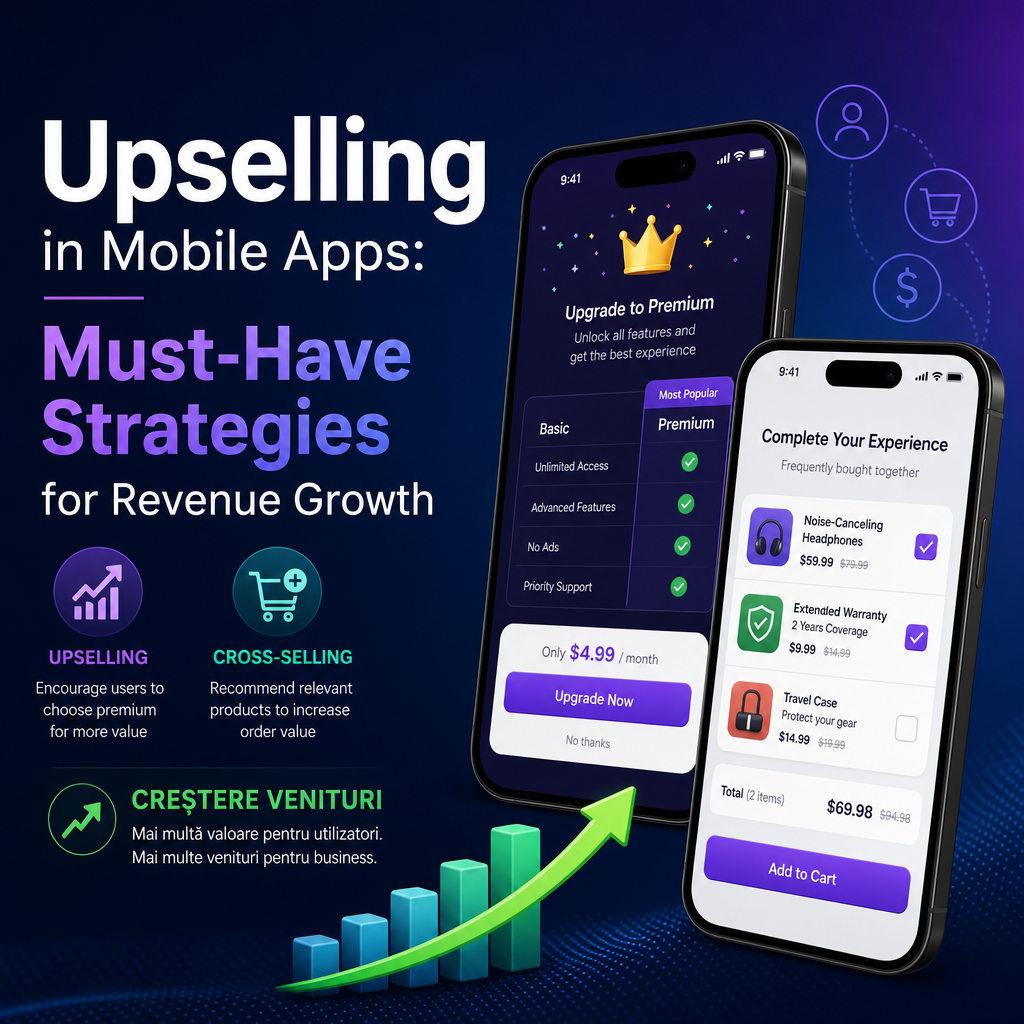
For example, a meditation app might offer a yearly premium subscription after a user has completed several free sessions. A photo editing app might highlight advanced filters, cloud storage, or export options available in a paid tier. These offers work best when they match what the user is already doing and solve a clear problem at the right moment.
In mobile environments, timing matters as much as the offer itself. Users are more likely to respond when they have already experienced value, reached a usage limit, or shown signs of deeper engagement. That is why the best upselling systems are built around user intent, not around generic sales pressure.
It also helps to think about the full mobile journey: onboarding, activation, engagement, retention, and upgrade. When each stage is connected, the app can gradually build trust before asking for a paid commitment. That trust is often the difference between a dismissed prompt and a successful conversion.
In practice, this means the product team needs to understand what motivates users, which features create the most value, and where friction appears in the free experience. The better those signals are mapped, the easier it becomes to present an upgrade that feels useful rather than disruptive.
Why Upselling Matters for Creștere Venituri
Mobile apps often operate with high acquisition costs and variable retention rates. That means relying on downloads alone is rarely enough. Upselling helps improve monetization from the users you already have, which is usually more efficient than constantly trying to bring in new users.
There are several reasons why upselling is so important for creștere venituri:
– It increases average revenue per user.
– It improves lifetime value.
– It supports freemium and subscription business models.
– It can reduce dependency on paid acquisition.
– It encourages users to discover more value in the app.
When users upgrade because they genuinely need additional features, they are often more satisfied with the product. That creates a healthier revenue model and can even improve retention. A user who sees a premium tier as a logical next step is usually more likely to stay engaged over time than a user who feels blocked too early.
Upselling is also valuable because it can improve the efficiency of your marketing. If an app converts a higher share of existing users into paying customers, the business has more room to reinvest in product development, support, and acquisition. This creates a stronger loop between growth and value delivery.
For mobile teams, that loop matters because the app store environment is crowded and switching costs are often low. A good upsell strategy helps you make more of each install instead of depending entirely on the next one. It turns retention into revenue, and revenue into more opportunities to improve the product.
For broader context on app monetization and subscription guidance, Google’s official subscription setup documentation is a useful reference.
The Difference Between Upselling and Cross-Selling
Although the two strategies are often mentioned together, they are not the same.
Upselling encourages users to choose a better or more expensive version of what they already want. Cross-selling, on the other hand, suggests related products or features that complement the main purchase.
For instance:
– Upselling: upgrading from a basic music plan to a premium ad-free plan.
– Cross-selling: suggesting a concert ticket app or merchandise store after the music subscription purchase.
Both can support creștere venituri, but they should be used differently. Upselling usually works best when the user is already close to a purchase decision. Cross-selling is often stronger when the user has already shown interest in a broader ecosystem of features or products.
The distinction matters because the message, timing, and design of each offer should match the user’s mindset. A cross-sell that appears too early can distract from the main upgrade. Likewise, an upsell that comes after the user has already committed may feel unnecessary. When the two are separated clearly, the app can guide users more naturally toward the right next action.
In a subscription app, for example, upselling might mean moving from monthly to annual billing or from basic to premium. Cross-selling might mean adding a related service, downloadable resource, or support package. Both can increase value, but they solve different business goals.
Must-Have Upselling Strategies for Mobile Apps
1. Use Behavior-Based Triggers
The most effective upselling happens when offers are triggered by user behavior rather than shown randomly. Users should see premium suggestions that relate to what they are doing in the app.
Behavior-based triggers include:
– reaching a feature limit
– using a function repeatedly
– completing a key action several times
– viewing premium content multiple times
– spending a long time in the app
If someone frequently uses a free scheduling tool, for example, an upgrade offer for automation or team collaboration may feel natural. This approach makes the upsell more relevant and increases the chance of conversion.
The strongest trigger is usually the moment of frustration or limitation. If users cannot complete the job they came to do, and a paid plan solves that problem clearly, the offer feels helpful. This is one reason why usage caps, export limits, and feature gating are common monetization tools in mobile products.
That said, the trigger should still respect the user experience. If you interrupt too early, users may never reach the “aha” moment. If you wait too long, the motivation can fade. The ideal timing depends on how quickly a user experiences value and how obvious the premium benefit is.
2. Offer Value Before the Ask
Users are more likely to upgrade after they have already experienced meaningful value. If the app is too aggressive with premium prompts early on, users may feel pressured and leave.
A strong strategy is to let users explore core features freely, then show the benefits of upgrading once they understand what they are missing. This is especially important in freemium apps, where the free tier should create enough trust and engagement to make a premium offer credible.
The message should answer one simple question: why is this upgrade worth it right now?
One way to do this is by framing the premium tier around a clear outcome. Rather than describing a feature in isolation, explain how it saves time, removes friction, or unlocks a better result. A user is much more likely to pay for “export unlimited projects in high quality” than for a vague promise of “extra capabilities.”
It also helps to let users feel progress before asking them to upgrade. If they have already completed tasks, saved content, or made improvements inside the app, they can better understand how the premium version extends that progress. This turns the upgrade into the next logical step, not an interruption.
3. Make Premium Benefits Clear and Specific
Vague sales language is less effective than clear, concrete value. Users need to understand exactly what they gain by upgrading.
Instead of saying “Unlock more features,” say something like:
– Remove watermarks
– Export in high resolution
– Save unlimited projects
– Get faster support
– Access advanced analytics
Specific benefits reduce friction and help users compare free versus paid options. The clearer the value, the stronger the upsell.
This clarity also reduces refund risk and post-purchase regret. When people know exactly what they are buying, they are less likely to feel disappointed later. In subscription products, that clarity is especially important because users are committing to a recurring payment rather than a one-time action.
A practical way to improve clarity is to group benefits by outcome. For example, one group may focus on productivity, another on convenience, and another on professional quality. That helps users understand not only what the plan contains, but why it matters to them.
4. Create Smart Paywalls
Paywalls are often the main moment where upselling happens in mobile apps. A good paywall does not just block access; it explains the benefit of upgrading at the moment of need.
A smart paywall should:
– appear after a valuable action
– show what the user gets in the premium version
– keep the design simple and readable
– offer one or two clear options, not too many
– avoid making the user feel trapped
The best paywalls feel like a logical next step, not a punishment for using the app.
They should also be optimized for mobile usability. That means large enough touch targets, clear typography, and a visual hierarchy that helps the user quickly scan the offer. On a small screen, clutter can kill conversions faster than a slightly higher price.
A well-designed paywall can include a short headline, a single supporting sentence, a few benefit bullets, and one primary call to action. If you need to include a free trial, annual savings, or a cancellation note, keep it visible but not overwhelming. The goal is confidence, not confusion.
5. Personalize Offers Based on Segments
Not every user should see the same upsell. Segmentation allows you to tailor offers based on user behavior, preferences, subscription status, or usage frequency.
For example:
– new users might respond to a low-cost trial
– power users may prefer annual plans
– inactive users may need a reminder of premium value
– teams may be interested in collaboration features
– creators may want higher export limits or branding tools
Personalized offers usually perform better because they match user intent. This improves both conversion rates and overall creștere venituri.
Segmentation can be simple at first. You do not need a complex machine-learning setup to get started. Even basic rules, such as “users who reached the limit three times” or “users who finished onboarding but did not subscribe,” can make offers much more relevant.
As the app grows, you can refine segments using lifecycle data, device type, engagement frequency, and feature usage patterns. The more accurate the segment, the more likely the offer will feel useful instead of generic.
6. Use Cross-Selling to Reinforce Upselling
Cross-selling can support upselling when the extra product or feature deepens the user’s commitment to the app ecosystem. For example, a budgeting app may offer premium reports and also suggest connected bank integrations. A learning app may upsell a subscription while cross-selling workbooks or live coaching.
When cross-selling is relevant, it can increase perceived value and make the main upgrade more attractive. However, keep the recommendations useful and limited. Too many offers can overwhelm users and weaken trust.
The best cross-sell is one that supports the same goal as the upgrade. If the premium plan helps users save time, the companion offer should also improve efficiency. If the app is focused on creativity, the related product should help users create more easily or with better quality.
This is where thoughtful product design matters. A well-timed recommendation can increase the value of the original purchase and make the user feel understood. A poorly timed one can feel like clutter. The difference is usually relevance and restraint.
7. Test Pricing and Offer Timing
There is no single perfect upselling formula. The best results often come from ongoing testing. Small changes in price, wording, offer placement, or timing can have a major impact on revenue.
Test variables such as:
– monthly versus yearly pricing
– free trial length
– button text
– offer timing after specific actions
– one-time purchase versus subscription
– in-app banner versus modal prompt
A/B testing helps identify what users respond to most. Over time, this can create consistent improvements in creștere venituri.
You can also test the emotional tone of the message. Some audiences respond better to practical language focused on productivity, while others prefer aspirational language that highlights convenience or status. The key is to keep the offer honest while adjusting the framing for better performance.
Pricing tests should be treated carefully. A lower price may improve conversion but reduce long-term value, while a higher price may filter for more committed users. The right answer depends on product margins, retention, and the overall subscription mix. Testing gives you evidence instead of guesswork.
8. Design a Better Upgrade Path
A strong upgrade path feels like a natural extension of the product. Users should be able to compare plans quickly, understand the main difference, and move forward without friction.
That means using concise copy, visible pricing, and a clean layout that works well on smaller screens. It also means avoiding pressure tactics that can make the app feel less trustworthy. In many cases, a calm and confident presentation outperforms aggressive sales language because it respects the user’s decision-making process.
A good upgrade path also answers the practical questions users ask before they pay:
– What do I get?
– How much does it cost?
– Can I cancel easily?
– Will this solve my problem?
When those answers are easy to find, the user does not have to work hard to make a decision. That reduces drop-off and increases the likelihood of upgrade.
It can also help to place the upgrade path in context. If users are leaving a screen because they hit a limit, the next step should take them to a focused comparison or checkout flow rather than to a generic homepage. Every extra tap adds friction, and friction lowers conversion.
9. Use Social Proof Where It Adds Confidence
When appropriate, social proof can help reduce hesitation. If users are unsure whether a premium upgrade is worth the price, a short testimonial, review snippet, or usage statistic can reinforce the decision.
For example, a note such as “Used by 10,000+ teams” or “Rated 4.8/5 by active subscribers” can increase confidence. Keep it honest, specific, and relevant to the offer. Social proof should support the value proposition, not distract from it.
Social proof works especially well when the user is close to buying but still needs reassurance. It can confirm that others have found value and that the product is reliable. If the proof is too generic, though, it loses impact. Specific statements tied to real user outcomes are much stronger.
In some apps, social proof can also highlight community behavior, such as the most popular plan or the most frequently used premium feature. That can make the upgrade feel more normal and reduce the perceived risk of trying something new.
10. Align Upsells With the Product Journey
One of the most overlooked strategies is simply aligning the offer with the current stage of the product journey. A user who just signed up needs education. A user who has completed several tasks may need efficiency. A user who has hit a ceiling may need an upgrade. A user who has returned repeatedly may need a stronger reason to commit.
When upsells match the journey, they feel natural. When they do not, they create friction. This is why product teams often map offers to lifecycle events such as onboarding completion, feature adoption, milestone achievement, or inactivity. These moments provide strong context for a premium prompt.
A journey-aligned upsell can also support better long-term retention. Instead of pushing the same message to everyone, the app responds to where the user actually is. That sensitivity creates a more human-feeling experience and usually improves revenue quality, not just revenue quantity.
11. Use Trial-to-Paid Transitions Carefully
Free trials can be an excellent upselling mechanism if the transition to paid feels fair and transparent. The trial should give enough access to prove value, but not so much that the paid version feels unnecessary. The best trials are designed to create familiarity, build habits, and make the premium benefits obvious before the billing decision arrives.
To improve trial conversion, communicate clearly about when the trial ends, what happens next, and how users can manage their subscription. Hidden billing terms damage trust and can hurt the long-term reputation of the app. A transparent process may not maximize every short-term conversion, but it usually produces healthier customers and better retention.
It also helps to show progress during the trial. If users can see what they have accomplished, they are more likely to value continued access. Progress is powerful because it reminds users of what they could lose if they do not upgrade.
12. Keep the Copy Human and Benefit-Focused
The language you use in an upsell can make a big difference. Users do not respond well to jargon-heavy or overly promotional messages. They respond to clear, human language that explains the benefit in a way they immediately understand.
Good copy usually does three things: it names the problem, shows the solution, and explains the result. For example, “Export without watermarks so your work looks professional” is much more persuasive than “Upgrade now for premium access.” The first line speaks to outcome; the second only talks about the action.
When your copy stays benefit-focused, users are less likely to feel manipulated. That matters because trust is a central part of mobile monetization. If the message feels respectful, people are more open to the offer.
Common Mistakes to Avoid
Even strong upselling strategies can fail if they are poorly executed. Some common mistakes include:
– showing offers too early
– hiding the value of premium features
– using too many interruptions
– making cancellation difficult
– promoting upgrades that do not match user needs
– ignoring mobile usability and screen size
The mobile experience should always feel smooth. If users have to struggle to understand the offer, the upsell will lose effectiveness. A bad upsell can damage trust and hurt retention, even if it generates short-term clicks.
Another common issue is overpromising. If the premium plan does not clearly improve the user’s real outcome, the offer may convert once but fail to retain customers. In subscription businesses, that is a costly mistake because churn can erase the value of the initial sale.
It is also important to avoid repetitive prompts. If users see the same upgrade message every time they open the app, they may become blind to it or actively annoyed by it. A better strategy is to vary the timing, format, and message based on behavior and lifecycle stage.
Finally, do not forget the checkout experience. A great upsell can still fail if the payment flow is clunky, slow, or confusing. The path from interest to purchase should be as smooth as possible on mobile.
How to Build a Better Upselling Experience
To make upselling work in mobile apps, focus on relevance, timing, and clarity. Think of every offer as part of the user journey, not a separate sales pitch. The best upsells feel like help at the exact moment a user needs more.
A practical framework is:
1. identify the user’s goal
2. recognize when they hit a limitation
3. present a useful premium solution
4. keep the choice simple
5. follow up with value-based messaging
This approach makes monetization feel more natural. It also helps users see premium features as an investment in better results rather than a forced expense.
If you want to validate user behavior, product teams often combine in-app analytics with event tracking from tools such as Google Firebase Analytics documentation.
From a process standpoint, it helps to define a clear hypothesis before every upsell experiment. For example, you might test whether users who have completed three key actions respond better to an annual offer than to a monthly offer. That kind of hypothesis-driven approach keeps the team focused on learning, not just on pushing promotions.
You should also review performance by segment instead of only looking at total conversion. A paywall that works well for new users may fail for power users. A reminder that performs well on Android may behave differently on iOS. Mobile growth improves faster when the data is broken into meaningful slices.
Lastly, remember that a great upsell does not end at the purchase click. Post-purchase onboarding matters too. If users buy premium but do not quickly discover the value they paid for, they may regret the decision. That is why the first premium experience should be polished, guided, and clearly better than the free one.
Practical Examples of Upselling in Mobile Apps
To make the strategy more concrete, it helps to look at how upselling can work in different app categories.
In a fitness app, a user may begin with basic workouts and then be offered advanced training plans, personalized coaching, or nutrition guidance after a few successful sessions. The upgrade works because it builds directly on behavior the user already values.
In a productivity app, a free user might be allowed to create a limited number of projects. Once they approach that limit, an offer for unlimited projects, team access, or advanced automation becomes highly relevant.
In a design app, free exports might include a visible watermark. The premium version could remove the watermark, unlock brand kits, and provide higher-resolution files. The user immediately understands the practical benefit.
In a learning app, the free version can offer introductory lessons, while the paid tier adds certifications, expert feedback, or offline access. Because the user has already invested time in learning, the upgrade feels like a continuation of that investment.
These examples show a common pattern: the most effective upsells do not feel separate from the product. They extend the user’s current behavior in a useful way.
How Upselling Supports Long-Term App Growth
Upselling is not just a short-term revenue tactic. When it is done well, it supports long-term product growth by improving monetization quality, reinforcing product-market fit, and encouraging deeper use of the app.
Higher revenue per user gives the business more flexibility. It can fund better onboarding, faster product iteration, stronger customer support, and more experimentation. In turn, those improvements make the product more valuable, which can further improve conversion and retention.
This is why upselling should be treated as part of the product strategy, not only the marketing strategy. If the premium offer is well aligned with the core experience, it can guide product decisions too. Teams may discover which features users value most, where limits create the most frustration, and which benefits most strongly drive upgrade intent.
That insight is often more valuable than the immediate sale. It helps the app evolve into a stronger business over time.
Final Thoughts
Upselling in mobile apps is much more than adding a few upgrade buttons. It is a strategic approach to monetization that can significantly improve creștere venituri when executed with care. By using behavioral triggers, clear value propositions, personalized offers, and smart paywalls, app creators can encourage upgrades without harming the user experience.
Cross-selling can strengthen this process by adding relevant complementary options, but the main goal should always be to deliver value first. Mobile users are more willing to pay when they feel understood, supported, and confident that the upgrade genuinely improves their experience. When that balance is achieved, upselling becomes one of the most reliable revenue growth tools in the app business.
With the right mix of timing, specificity, and restraint, the mobile app can become a powerful and sustainable instrument of sales growth. For teams that want better results, the opportunity is not just to sell more, but to sell in a way that feels useful, fair, and genuinely aligned with what users need.
That is the real advantage of a well-built mobile upsell strategy: it creates stronger monetization while still respecting the user journey. And in a crowded app market, that combination is both practical and profitable.